

Analysis of the production process of plastic abalone rings
Release time:2025-03-05
As an important product in the field of tower packing, the production process of plastic abalone rings directly affects the effectiveness of chemical separation, environmental protection, and other scenarios. This paper focuses on the three major aspects of raw material selection, molding process, and quality control, and analyzes the key technologies in the production process.
First, raw material selection: the science of materials to match the scene
Plastic Bauer ring materials need to take into account corrosion resistance, mechanical strength, and cost-effectiveness, the mainstream choices include:
1, polypropylene (PP): suitable for acidic or alkaline media environment, good melt flow, suitable for complex structure injection molding;
2, high-density polyethylene (HDPE): strong impact resistance, suitable for sewage treatment in the high-flow conditions;
3, polyvinyl chloride (PVC): outstanding temperature resistance, but need to assess the long-term impact of chlorine elements on specific media.
Raw materials need to be tested by the melt index (MI value) to ensure that it matches the molding process. Some companies extend the service life in outdoor environments by adding modifying additives such as anti-UV agents and antioxidants.
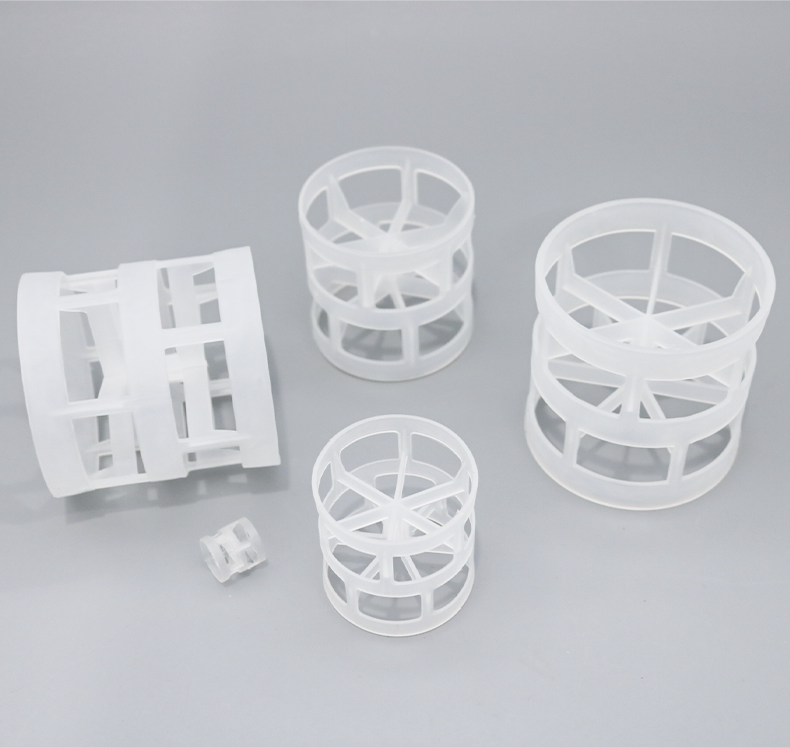
Second, the molding process: the technical balance of precision manufacturing
The molding of plastic Bauer rings relies on two types of processes: injection molding and extrusion, the choice of which is based on product specifications and performance requirements:
1、Injection molding
Molds using high-temperature alloy steel, window structure, and internal and external rib layout to achieve a balanced distribution of gas-liquid;
Process parameters control (such as PP barrel temperature 200-230 ℃) affect the finished product shrinkage and dimensional stability;
Post-treatment includes burr cleaning and annealing to eliminate residual stress.
2、Extrusion molding
Extruded through the screw tubular embryo, thermoforming process for large-size ring structure (such as DN80 or more);
The advantage lies in cost control, but the wall thickness uniformity requirements are higher and need to cooperate with the online monitoring system.
Third, quality control: a multi-dimensional system of performance verification
Finished products need to pass three types of core testing:
1, physical properties: bulk density, and porosity determine the mass transfer efficiency, compressive test simulates the tower pressure state;
2, chemical compatibility: through the media immersion experiment to verify the swelling rate and corrosion resistance;
3, structural consistency: the use of optical measurement technology to ensure that the distribution of window holes and ring diameter error ≤ 1.5%.
Fourth, process upgrading: intelligent and sustainable paths
Industry technology iteration presents two major directions:
1, intelligent production
Mechanical arm automatic pickup, visual recognition quality inspection system to reduce manual errors, and improve batch stability;
2, green manufacturing
Injection molding waste is crushed and granulated to achieve a recycling rate of more than 95%;
Electromagnetic heating technology reduces energy consumption by about 30%, reducing the carbon footprint of production.
Fifth, Technology integration and future trends
Computational Fluid Dynamics (CFD) simulation technology is being used to optimize Bauer ring structure design. For example, a company improved the mold through window hole distribution simulation to reduce the pressure drop of the styrene separation tower by 18%. In the future, the combination of polymer material modification technology and digital design will promote the production process from “experience-driven” to “data-driven”.
Conclusion
The production of plastic abalone rings is a cross-cutting field between materials engineering and manufacturing technology, which requires a dynamic balance between cost, performance and environmental protection. As the requirements of separation technology increase, process innovation will continue to be the focus of competition in the industry.
RELATED INFORMATION


Customer Service Hotline
Tel/WeChat/WhatsApp: +86 18079994732
E-mail/Zoom: Lynn@pxrjhb.cn
Address: No. 1-269, Zone B, Industrial Park, Xiangdong District, Pingxiang City, Jiangxi Province
 Customer Service
Website construction:300.cn