

Difference between inert ceramic balls and catalysts
Release time:2025-03-21
Release time:2025-03-21
In the chemical industry, oil refining, environmental protection, and other industrial fields, much key equipment can be seen in two seemingly similar but very different functions of the material - inert ceramic ball and catalyst. They are like ‘twin brothers’ on the industrial production line, but play very different roles in their respective positions.
Firstly,functional positioning: physical support vs chemical acceleration
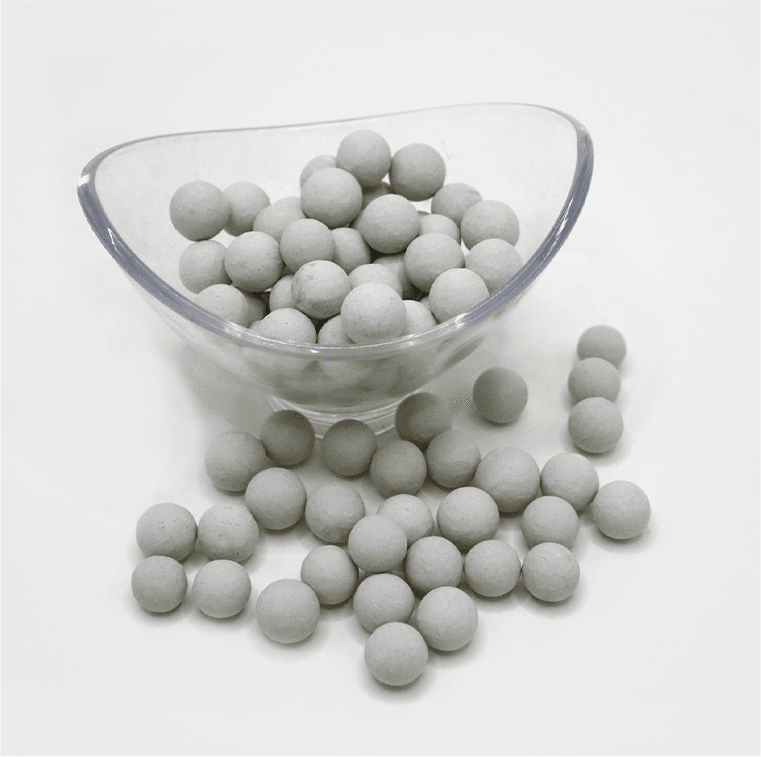
The core role of an inert ceramic ball is physical support and fluid distribution. It is usually laid at the bottom of the reactor or tower as a packing material to provide a stable support structure for the catalyst above, preventing the catalyst from being lost due to gravity or fluid impact. In addition, the porous structure of the inert ceramic ball evenly disperses the gas or liquid entering the equipment, ensuring that the material is in full contact with the catalyst. This role of ‘silent guardian’ lays the foundation for the stability of the entire production process without participating in the chemical reaction.
The mission of the catalyst, on the other hand, is to accelerate the chemical reaction. By lowering the activation energy of the response, it enables reactions that would otherwise require harsh conditions such as high temperatures and high pressures to take place in a gentler environment, thereby increasing productivity and reducing energy consumption. Although catalysts are involved in chemical processes during a reaction, their chemical properties and qualities remain essentially unchanged before and after response, so they can be reused. This ‘reaction accelerator’ characteristic makes them a central driving force in many industrial processes.
Second, the core components: inert materials vs active substances
The main components of inert ceramic balls are chemically stable materials such as alumina and silica. These materials have the characteristics of high-temperature resistance, corrosion resistance, and high mechanical strength, and can work stably for a long time in harsh industrial environments. For example, in a catalytic cracking unit in an oil refinery, the inert ceramic balls need to withstand high temperatures of hundreds of degrees Celsius and the scouring of oil and gas, while their inert composition ensures that they do not react with the material and always maintain the function of physical support.
Catalysts are much more complex, often containing metals, metal oxides, or other active substances. For example, ternary catalysts for automotive exhaust treatment contain precious metals such as platinum, palladium, and rhodium, which are capable of converting hazardous gases into harmless substances, while molecular sieve catalysts, commonly used in chemical production, use silica-aluminum salts as the carrier and are loaded with active metal components. These active components are the key to the catalyst's function, as they accelerate the reaction process by changing the reaction path through specific chemical interactions with the reactants.
Thirdly,application Scenarios: Basic Support vs Core Reaction
The application of inert ceramic balls is relatively fixed, mainly in equipment that needs to support and disperse fluids. For example, in a synthesis tower for fertilizer production, the inert ceramic ball is laid at the bottom and the catalyst for ammonia synthesis is loaded on top. Not only does it support the weight of the catalyst, but it also distributes the hydrogen and nitrogen gases entering the tower evenly, ensuring that the reaction proceeds efficiently. In addition, inert ceramic spheres are used as fillers in aeration tanks for wastewater treatment, helping to spread the bubbles evenly and improving oxygen utilization.
The use of catalysts is directly linked to various chemical processes. In petroleum refining, catalysts are used to crack heavy oil and improve the quality of gasoline; in the pharmaceutical industry, catalysts are used to accelerate the key step of drug synthesis; in the field of new energy, catalysts are also used in the reaction of fuel cells to promote the conversion of hydrogen and oxygen. In the new energy field, catalysts are also used in fuel cell reactions to facilitate the conversion of hydrogen and oxygen. It can be said that wherever there is a need to accelerate chemical reactions, catalysts are almost indispensable.
Fourth, the mechanism of action: physical properties vs chemical adsorption
The action of inert ceramic spheres is entirely dependent on their physical properties. Its hard texture provides mechanical support, porous structure to promote fluid distribution, and chemical inertness to ensure that it does not participate in the reaction. This ‘passive’ approach means that inert ceramic spheres are often regarded as a ‘supporting role’ in industrial equipment, but their importance is irreplaceable - if the support structure fails, the entire If the support structure fails, the entire reaction system may collapse.
The mechanism of catalyst action is dominated by chemisorption and surface reactions. When reactant molecules are adsorbed on the surface of the catalyst, the active sites of the catalyst interact with the reactants and change the state of their chemical bonds, thus reducing the activation energy of the reaction. For example, in the ammonia reaction, the active sites on the surface of an iron-based catalyst can adsorb nitrogen molecules and break their chemical bonds, which in turn combine with hydrogen to form ammonia. This ‘active’ chemical intervention makes the catalyst a central regulator of the chemical reaction.
Conclusion: Each has its role to play in building the cornerstones of industry.
Inert ceramic balls and catalysts, although very different in function, composition, and mechanism of action, complement each other in industrial production. The inert ceramic ball provides support for the reaction system with its stable physical properties, while the catalyst accelerates the reaction process with its efficient chemical activity. Both are like the ‘twin engines’ of industrial production, jointly promoting the development of the chemical industry, energy, environmental protection, and other fields. An in-depth understanding of their differences not only helps to optimize the production process but also provides an important reference for the development and application of new materials. In the future industrial upgrading, these two materials are expected to continue to play their respective advantages and contribute to sustainable development.
RELATED INFORMATION


Customer Service Hotline
Tel/WeChat/WhatsApp: +86 18079994732
E-mail/Zoom: Lynn@pxrjhb.cn
Address: No. 1-269, Zone B, Industrial Park, Xiangdong District, Pingxiang City, Jiangxi Province
 Customer Service
Website construction:300.cn