

Industrial decarbonisation of carbon-neutral honeycomb ceramic heat accumulators
Release time:2025-03-31
Release time:2025-03-31
I. Technological breakthroughs and challenges in global industrial decarbonization
Against the background of accelerated transformation of the global energy structure, carbon emission reduction in the industrial sector has become a key link in achieving the goal of carbon neutrality. Data show that industrial energy consumption accounts for more than 40% of the world's total energy consumption, while the thermal efficiency of traditional industrial furnaces and kilns is generally less than 60%, energy waste and carbon emissions are prominent. Honeycomb ceramic heat accumulators, as the core component of the thermal storage high-temperature combustion (HTAC) technology, can increase the thermal efficiency of industrial furnaces and kilns to more than 85% through the mechanism of waste heat recovery, significantly reducing fuel consumption and carbon emissions.
Taking the iron and steel industry as an example, the energy-saving renovation of a steel plant's heating furnace through the use of a honeycomb ceramic heat storage body reduces fuel consumption by 30% and carbon dioxide emissions by 120,000 tonnes per year. This technological breakthrough not only verified the honeycomb ceramic heat storage body in the industrial decarbonization of the actual value but also for other energy-consuming industries to provide a solution.
II, the technical principle of cellular ceramic heat storage body and innovative applications
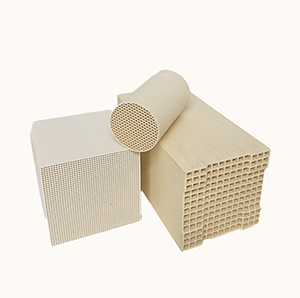
The honeycomb ceramic heat storage body's core advantage lies in its unique porous structure design. Its internal composition of thousands of parallel pores, with a specific surface area of 1000m²/m³ or more, is three times the traditional ceramic ball. This structure enables the heat accumulator to exchange heat in a very short time and realize waste heat recovery from exhaust gases. For example, in metallurgical heating furnaces, heat accumulators can preheat combustion air to more than 1000°C, allowing fuel to be burned more fully, thereby reducing carbon emissions by 15-20%.
In recent years, advances in materials science have led to upgrades in the performance of honeycomb ceramic heat accumulators. The new mullite-corundum composite material has a temperature resistance of more than 1600℃, a thermal shock temperature difference of 800℃, and a service life of more than 5 years. Meanwhile, the application of nano-coating technology on the surface effectively improves the corrosion resistance of the material, enabling it to operate stably in industrial environments containing sulfur, chlorine, and other acidic gases.
III,Typical cases and implementation path of industrial decarbonization
Iron and steel industry: A large-scale iron and steel enterprise has improved the thermal efficiency of its heating furnace from 58% to 87% by transforming the furnace into a heat storage type and adopting a honeycomb ceramic heat storage body with 40×40 holes and a wall thickness of 0.7mm, which saves 12 million cubic metres of natural gas and reduces the carbon dioxide emission by 32,000 tonnes per annum. The successful implementation of this project provides a model for the low-carbon transformation of the iron and steel industry.
Chemical industry: A chemical plant applied a honeycomb ceramic heat accumulator in the RTO (Regenerative Thermal Incinerator) system to increase the treatment efficiency of VOCs (Volatile Organic Compounds) to more than 98%, and at the same time, the recovered heat was used in the production process, realizing the gradual utilization of energy. After the operation of the project, the annual carbon emission is reduced by 18,000 tonnes, and the comprehensive energy-saving benefit reaches RMB 30 million.
Building materials industry: a ceramic enterprise in the kiln renovation using layered cellular ceramic heat storage body, near the furnace side of the use of large holes and thick-walled structure (4mm aperture, 1.2mm wall thickness), the back row of small holes and thin-walled (2.8mm aperture, wall thickness of 0.8mm), a balance of the heat transfer efficiency and resistance to clogging capacity. After the transformation, the energy consumption of the kiln is reduced by 25%, and the comprehensive qualification rate of the products is increased by 3 percentage points.
IV, policy-driven and industry development trend
Globally, industrial decarbonization policies are accelerating. The European Union's Industrial Emissions Directive’ requires that the energy efficiency of industrial furnaces and kilns be by 20% before 2030, the U.S. ‘Inflation Reduction Act’ on the use of heat storage technology to provide tax credits to enterprises. These policies are for the promotion of cellular ceramic heat storage bodies to create a favorable environment.
From the technical development trend, honeycomb ceramic heat storage body is towards intelligent, customised direction. The application of digital twin technology can simulate the operating state of the heat storage body in real time, predict the trend of pressure drop to achieve preventive maintenance. 3D printing technology provides the possibility of complex hole design, further optimizing the airflow distribution and heat transfer efficiency.
V. Future Outlook and Recommendations
With the advancement of carbon neutrality, the honeycomb ceramic heat accumulator market will see rapid growth. According to industry forecasts, the global market size will exceed USD 2 billion in 2025, with a compound annual growth rate of 15%. To give full play to its role in industrial decarbonization, it is recommended that:
Strengthen cooperation between industry, academia and research: Promote the deep integration of materials research and development, equipment manufacturing and industrial applications, and accelerate the industrialisation of new heat storage body.
Improve the standard system: the establishment of cellular ceramic heat storage body performance evaluation and testing standards, regulate the market order.
Promote integrated solutions: combining heat storage technology with new energy and intelligent control to create a low-carbon industrial ecology.
Honeycomb ceramic heat storage body as the key technology of industrial decarbonization, is reshaping the global industrial energy use model. Through technological innovation and policy guidance, this technology will provide solid support for achieving the goal of carbon neutrality and help the green transformation of the industrial sector.
RELATED INFORMATION


Customer Service Hotline
Tel/WeChat/WhatsApp: +86 18079994732
E-mail/Zoom: Lynn@pxrjhb.cn
Address: No. 1-269, Zone B, Industrial Park, Xiangdong District, Pingxiang City, Jiangxi Province
 Customer Service
Website construction:300.cn