

Multi-surface hollow ball to solve the problem of mass transfer efficiency
Release time:2025-03-31
Release time:2025-03-31
In the fields of chemical industry and environmental protection, mass transfer efficiency is the core index that affects the performance of equipment. Traditional fillers in the gas-liquid exchange process often face problems such as insufficient contact area and uneven fluid distribution, resulting in limited processing efficiency. In recent years, a new type of filler called multi-surface hollow ball has gradually become the focus of attention in the industry, and its unique structural design and material innovation provide a new path to improve mass transfer efficiency.
Firstly, structural innovation: from ‘solid ball’ to ‘multi-surface hollow’.
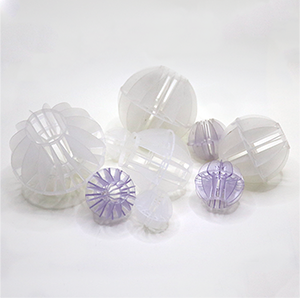
Multi-surface hollow ball consists of two hemispheres, each hemisphere surface distribution of 12 semi-fan-shaped blades, the upper and lower blades are arranged in a staggered manner, forming a radial structure. This design breaks through the limitations of traditional solid filler:
High specific surface area: the blade structure increases the surface area of the sphere greatly, for example, the specific surface area of φ50mm specification multi-faceted hollow sphere can reach 220m²/m³, which is 2-3 times of the ordinary packing.
Optimization of fluid dynamics: the hollow structure reduces the packing density (e.g. φ76mm specification packing density is only 39kg/m³), while the channel formed between the blades promotes gas-liquid turbulence and reduces fluid retention.
Anti-clogging ability: the reinforcing ring in the middle of the sphere provides structural stability and prevents the filler from being deformed or broken in the high-speed airflow.
Technical Challenge and Response: Early multi-faceted hollow spheres due to dense blades lead to uneven distribution of liquid (masking effect), part of the liquid in the sphere inside the aggregation, affecting the mass transfer efficiency. The industry has gradually solved this problem by adjusting the angle of the blades, optimizing the spacing of the spheres, and other measures, such as adopting a graded loading strategy in wastewater treatment equipment, so that the liquid evenly covers the surface of the packing.
Secondly,material Upgrade: The Leap from Plastic to Ceramic
The performance improvement of multi-faceted hollow balls cannot be separated from the progress of material science:
Traditional plastic fillers: polypropylene (PP), polyvinyl chloride (PVC), and other materials with corrosion resistance and low-cost advantages, widely used in gas purification, sewage treatment and other scenarios. For example, a copper wet smelting project uses a φ76mm polypropylene hollow ball, effectively inhibiting the volatilization of acid mist from the electrolysis tank, and reducing environmental pollution.
New ceramic materials: The sintered non-shrinkage foam ceramic hollow ball developed by a Tsinghua University team has achieved zero-shrinkage sintering through the self-assembly technology of metal particles, and its compressive strength reaches 14.8MPa, which is 2-10 times higher than that of traditional ceramics. This material performs well under high temperature and high-pressure environments and is suitable for demanding scenarios such as chemical reaction towers.
Surface modification technology: The mass transfer performance of fillers can be further enhanced by means of fluoride treatment and hydrophilic coating. For example, a team from Shaanxi University of Science and Technology introduced a MoC/NC heterogeneous interface on the surface of hollow spheres, which improves the charge transfer efficiency and shows potential in the field of electromagnetic wave absorption.
Thirdly,application cases: from laboratory to industrial site
The practical application of multi-surface hollow balls has covered many fields:
Sewage treatment: In a city sewage treatment plant, after the multi-surface hollow spheres replace the traditional Lacy ring packing, the oxygen transfer efficiency of the aeration tank is increased by 30%, the sludge degradation speed is accelerated, and the effluent water quality is significantly improved.
Gas purification: a power plant used φ50mm multi-surface hollow spheres to fill the carbon dioxide degassing tower, reducing the carbon dioxide content in the water from 20mg/L to less than 5mg/L, and reducing the load on the subsequent treatment equipment.
New energy field: in the production of lithium-ion batteries, multi-surface hollow spheres are used in the electrolyte circulation system, and their high porosity structure promotes ion diffusion and improves the charging and discharging efficiency of the battery.
Fourth, the industry outlook: from a single filler to system solutions
With the iteration of technology, the application scenarios of multi-faceted hollow spheres will be further expanded:
Modular design: customizing filler size and shape through 3D printing technology to meet the individual needs of different equipment.
Intelligent integration: Combining sensors and data analysis, real-time monitoring of packing performance, dynamic adjustment of process parameters, and maximization of mass transfer efficiency.
Green manufacturing: the use of industrial waste (such as slag, fly ash) to prepare ceramic hollow ball, reduce production costs while promoting the circular economy.
Expert Opinion: Experts from a chemical research institute pointed out that the core advantage of multi-faceted hollow ball lies in the synergistic innovation of ‘structure - material - process’. In the future, it is necessary to further study the interaction mechanism between filler and fluid, develop high-performance materials suitable for extreme environments, and provide support for industrial upgrading.
Conclusion
The emergence of multi-faceted hollow spheres marks the transformation of mass transfer equipment from ‘empirical design’ to ‘accurate regulation’. Through structural optimisation, material innovation and intelligent application, this new type of filler is reshaping the technological landscape of chemical and environmental protection industries. With the deepening of interdisciplinary research, multi-surface hollow spheres are expected to play a key role in more fields and provide technical guarantee for sustainable development.
RELATED INFORMATION


Customer Service Hotline
Tel/WeChat/WhatsApp: +86 18079994732
E-mail/Zoom: Lynn@pxrjhb.cn
Address: No. 1-269, Zone B, Industrial Park, Xiangdong District, Pingxiang City, Jiangxi Province
 Customer Service
Website construction:300.cn