

Manufacturing process of honeycomb zeolite molecular sieve
Release time:2025-03-28
Release time:2025-03-28
As a kind of silica-aluminate material with a regular pore structure, honeycomb zeolite molecular sieve, with its excellent adsorption performance, thermal stability, and environmental protection characteristics, shows great potential for application in the fields of waste gas treatment and catalytic conversion. The optimization and innovation of its manufacturing process are not only related to the improvement of material performance but also of great significance to the development of industrial greening.
Firstly, Raw material selection and pretreatment: high-value utilization of natural minerals
The synthetic raw materials of honeycomb zeolite molecular sieves mainly rely on natural non-metallic minerals, such as kaolin, diatomite, bentonite, and so on. These minerals are rich in silica and aluminum elements, with abundant reserves and low cost, providing the basis for green manufacturing.
Kaolin treatment: Kaolin needs to be roasted at high temperatures to remove the hydroxyl groups in the crystal lattice and form reactive metakaolin, which releases the silica-aluminium source that can be used to synthesise zeolites.
Diatomaceous earth advantage: Diatomaceous earth contains a large amount of amorphous silica and can be used directly in the synthesis without complex activation, significantly reducing energy consumption and process complexity.
Other mineral applications: bentonite through the acidification process to destroy the layered structure, remove impurities to obtain active silica-aluminium source; perlite tailings, gangue and other industrial waste can also be converted into zeolite synthesis of raw materials through the appropriate treatment, to achieve the recycling of resources.
Secondly, the synthesis process: from the solution to the accurate regulation of the crystal
The synthesis of honeycomb zeolite molecular sieves needs to be chemically converted into raw materials with regular pore crystal structure. Currently, the commonly used synthesis methods include hydrothermal synthesis, gas phase synthesis, etc., while innovative technologies such as the ‘one-step method in aqueous solution at room temperature’ are promoting the development of the process in the direction of higher efficiency and more environmentally friendly.
Hydrothermal synthesis: The raw material is mixed with a templating agent and the crystallization reaction is carried out under high temperature and pressure. For example, by controlling the temperature, pressure, and reaction time, the aluminosilicate solution gradually forms zeolite crystals.
Green synthesis innovation: The one-step method in aqueous solution at room temperature proposed by Shao Lu's group uses the dopamine polymerisation process to regulate the nucleation rate of ZIF-8 zeolite, which avoids the complex substrate treatment and high energy consumption in the traditional method. By delaying homogeneous nucleation and promoting heterogeneous nucleation, the method successfully prepared defect-free high-quality zeolite membranes, providing a new idea for the large-scale production of honeycomb zeolite.
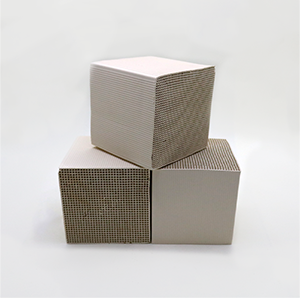
Thirdly, the molding process: from powder to honeycomb structure precision processing
The molding of the honeycomb structure is the key link in the preparation of the honeycomb zeolite molecular sieve, which directly affects its adsorption performance and gas permeability. At present, the extrusion molding process is mainly used to ensure the uniform distribution of zeolite materials.
Raw material mixing and granulation: Mix the synthesized zeolite powder with binder (such as ceramic fibre) and additives in proportion, and granulate it initially by swinging pellet machine, and then gradually increase the size of particles by using icing machine, and obtain the particles that meet the requirements of particle size after sieving.
Extrusion molding: The homogeneously mixed materials are fed into the extruder to form a honeycomb structure under pressure. This process does not require coating, which avoids problems such as poor bonding and powder fall, and ensures that the zeolite material is evenly distributed inside and outside the honeycomb.
Drying and roasting: After molding, the honeycomb zeolite needs to be dried and roasted. The drying process is usually carried out in a belt dryer with temperature control to ensure the uniform removal of moisture, while the roasting process is carried out in a roaster to enhance the structural stability and adsorption performance of the material by precisely controlling the temperature and time. For example, molecular sieves with different particle sizes need to be roasted at different temperature intervals to achieve good strength and adsorption effect.
Fourth, process advantages and application prospects
The manufacturing process of honeycomb zeolite molecular sieve shows significant advantages through the high-value use of raw materials, accurate regulation of the synthesis process, and optimization of the forming technology:
Environmental protection and energy saving: using natural minerals as raw materials reduces the dependence on chemical raw materials; innovative synthesis methods reduce energy consumption and pollutant emissions.
Excellent performance: the honeycomb structure provides a larger specific surface area and uniform pore channels, making it outstanding in the field of organic waste gas adsorption, catalytic combustion, etc., with a large adsorption capacity and can be regenerated and recycled.
Wide range of applications: suitable for coating, printing, chemical, and other industries, large air volume, low concentration of organic waste gas treatment, and its high-temperature resistance, and corrosion resistance characteristics further expand the industrial application scenarios.
With the increasingly stringent environmental requirements and the continuous upgrading of industrial technology, the manufacturing process of honeycomb zeolite molecular sieves will continue to develop in the direction of greening and intelligence. Through raw material innovation, process optimization, and equipment upgrading, it is expected to further improve material performance, reduce production costs, and provide stronger support for environmental protection and sustainable industrial development.
RELATED INFORMATION


Customer Service Hotline
Tel/WeChat/WhatsApp: +86 18079994732
E-mail/Zoom: Lynn@pxrjhb.cn
Address: No. 1-269, Zone B, Industrial Park, Xiangdong District, Pingxiang City, Jiangxi Province
 Customer Service
Website construction:300.cn